
Matthew’s Film Notes
“In my civil life, I’m a lover, I like to love. And in my films I was really austere, you know, you saw my first ones. And I felt it was really the time, I felt the responsibility as a filmmaker to offer something still meaningful, but with a levity.”
–Rebecca Zlotowski on A Private Life
It’s hard to know exactly how to characterise A Private Life: a wry exploration of the contemporary function of psychoanalysis, an idiosyncratic whodunnit, an amateur detective caper? Thierry Frémaux presented the film as a “screwball comedy” at the 78th Festival de Cannes press conference, and Philip Concannon suggests the film might best be understood “as an example of the comedy of remarriage subgenre.” Being hard to pin down is far from a bad thing.
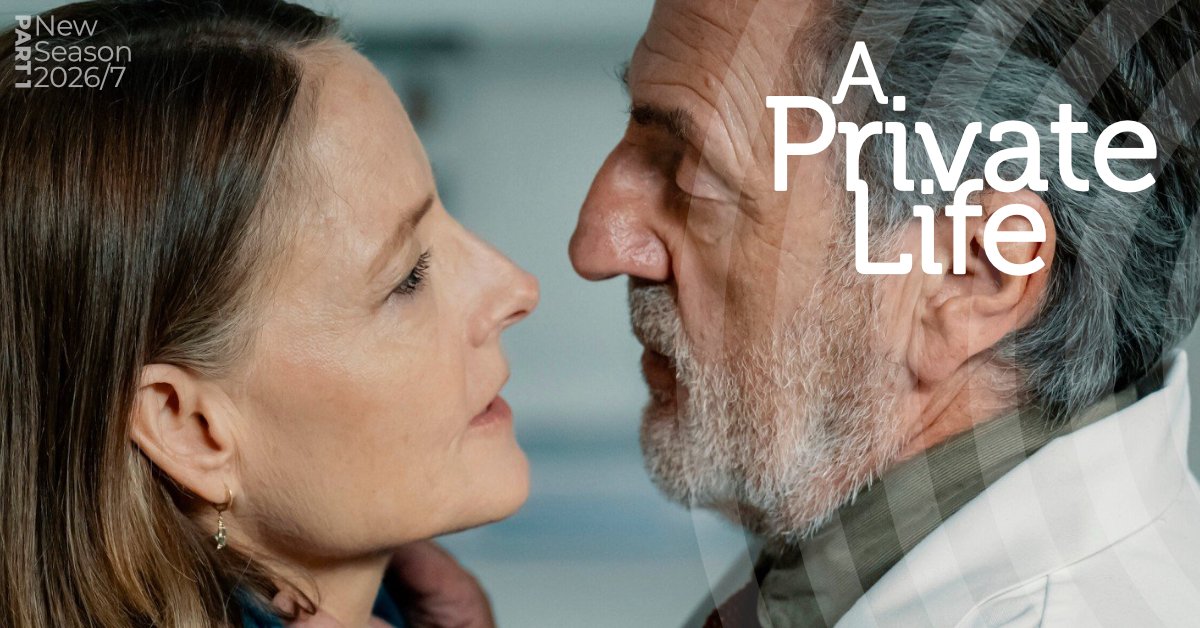
Director Rebecca Zlotowoski has fulfilled a purportedly lifelong dream by casting Jodie Foster as Jewish-American psychoanalyst Lilian Steiner, who resides and practises in Paris. We are introduced to Lilian as she is deserted by one client for the market alternative of hypnotism, and soon another of Lilian’s longstanding clients dies: Paula (Virginie Efira), whose wake is attended by Lilian, before she is abruptly thrown out by Paula’s husband (played by the esteemed Mathieu Amalric). Reeling in shock, and, perhaps, guilt, Lilian develops an unspecified disorder of uncontrollable weeping, turning her world upside down: now, the psychiatrist sits in tears, listening to her clients. Lilian fixates on Paula’s case and death, conspiratorially, sending her down multiple avenues of investigation, which turns the film into an almost knockabout caper.
Recently, David Cronenberg’s The Shrouds (2024) thematised the way conspiracy can function as a desire, when grieving, to find or create a coherent narrative for tragedy. Of grappling with grief, Cronenberg says: “It cannot be the truth, and if it’s not the truth, then you’re looking for the reason why this impossible thing happened. Some person, some force made it happen because why would it happen otherwise?” This is the vortex Lilian is sucked into, and it proves transformative, as Lilian’s ex-husband Gabriel (Daniel Auteuil) joins her in her pursuit. As Philip Concannon notes, “It’s a pleasure to watch these two great actors bounce off each other, as characters rediscovering the spark within themselves and in their relationship.”
A Private Life has, at times fleetingly, a storied cast: Irène Jacob, whose performance as Weronika/Véronique in The Double Life of Veronique (1991) was recently screened in our Summer Season, plays a professional confidant (wearing red, of course!) sharing a cigarette with Foster, and venerable documentarian Frederick Wiseman makes his final film appearance as an actor before his passing earlier this year. Aurore Clément, star of Louis Malle’s Lacombe, Lucien (1974)—Malle’s 1962 film Vie privée is referenced through A Private Life’s title—appears as octogenarian Perle Friedman, a ghost haunting Paula’s mind. Clément recalls, in an interview with Le Monde, “Rebecca spoke to me about a character, a survivor of the camps, who seems to have emerged from the night. So I brought to the set earrings that were given to me by Therese Giehse, a German actress who fled Nazism and with whom I acted in Lacombe, Lucien. I lost one on the set of Apocalypse Now (1979), and they made one out of papier-mâché for me…” That replica is the one that appears on screen in A Private Life. The cast is rounded out and made a family affair by Zlotowski’s father Michel, playing the rabbi who buries Paula; he has now featured in all her films since Planetarium (2016).
Perhaps surprisingly, A Private Life finds itself in the midst of a contentious debate and point of transition for the film industry: the integration of generative artificial intelligence (AI) into the production of moving image media. In a recent talk entitled Who Owns the Future of Hollywood?, Foster described Zlotowski’s experimentation with AI for visualising a journey into Lilian’s subconscious midway through the film:
“I did a film, a very small French movie that had no money at all, and we had a sequence that is like a dream sequence, but is kind of inside [Lilian’s] subconscious. The director fed the information into AI, and said, what would you spit out? And AI spat out images that made absolutely no sense, but were beautiful. They were weird, strangely emotional, referring back to some time in our past that we didn’t quite understand, and the director was able to dominate and contain what the computer didn’t really understand it was doing.
That’s a really good example of being able to dominate AI, which if we are able to do consistently, over time, we can make things that reflect us and make things better. However, will we be able to dominate this particular technology for more than a couple of years? I don’t know.”
Foster went on to suggest that recent Hollywood blockbuster F1 (2025) is a quintessential film of the emergent AI era: F1’s structure is “exactly the structure that you would learn in school”, and the actors say lines exactly how a computer would write them. In this light, it’s easy to see why A Private Life appealed so much to Foster: not just the challenge of performing in a non-native language (Foster has said learning lines gets much harder with age, particularly so in another language!), but the project’s quirkiness, unpredictability, its overspill of unsettled, cyclical human relations and compulsions. Lilian uses an older technology, the now fully obsolete MiniDisc, to record her sessions of psychoanalysis; it is hopefully not a spoiler to say that she eventually outgrows the format. Technology comes and goes, and the act of listening and understanding remains a deeply human occupation.
Audience Comments
- Amusing, thrilling, funny. A great film! And wow – Jodie Foster’s French is amazing!
- Fascinating! Studied reflections of characters. Subtle but relatable
- Captivating. Jodie in every scene
- Very French with American style!
- Loved this film – so many twists and beautifully acted. Very atmospheric and loved hearing another language
- “Bloody French!” PS Does it never stop raining?
- Fascinating and farce in equal measure. Rubbish music
- Absurd and boring. Great music though
- I didn’t really get the plot but she enjoyed it